Newton's Second Law and Tug of War
As a consequence of Newton's Second Law, three forces applied to the same object may or may not balance.
- A two-way tug of war will produce a winner when one team can produce a net force on the rope.
- The video linked below will show a four-way tug of war. You can think of the teams as North vs. South, and East vs. West, when the action begins. You can guess what will happen if there is a net force in the North and the West directions.
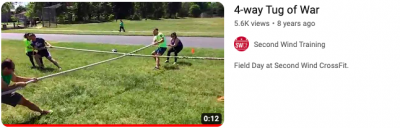
- After the initial release, though, the four teams may be pulling at a slightly different angle than when they started. That makes predictions a little more complex. Converting a diagonal force into two components is the tool that will make accurate predictions possible.
This exercise starts with a three-way tug-of-war, in which three teams try to move a central ring away from its central point. If one side starts to win, the other two can change the angle of their pull to try and resist the net force. Predicting the results can be easier if each force is converted into components that lie along a common set of lines.
You can see this concept in action in the following two video clips:
The interactive page, captured in the image below, will allow you predict whether a particular set of starting angles will result in a net force. Can you adjust the vectors and make the net force equal to zero, making the tug-of-war a stalemate?
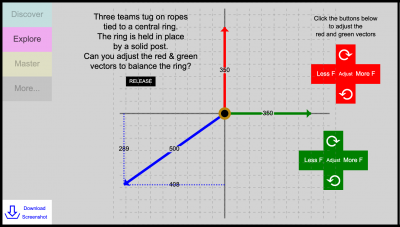
The Discover tab give you a chance to study the vectors and make a prediction.
The Explore tab gives control over the magnitude of the forces of the two weaker sides. (In other words, you can make the red and green teams pull harder when necessary, and ease up when necessary.)
The Master tab gives control over the direction of the forces of the two weaker sides. (In other words, you can make the red and green teams pull in different directions.)
The More tab leads here.
Interested in Tug of War strategy (via Squid Games)? Click Here!